

How Overcomplicated CRMs Create More Work
Feb 4, 2026
Here’s the thing.
CRMs are supposed to make life easier.
But a lot of them don’t. Actually, many do the opposite.
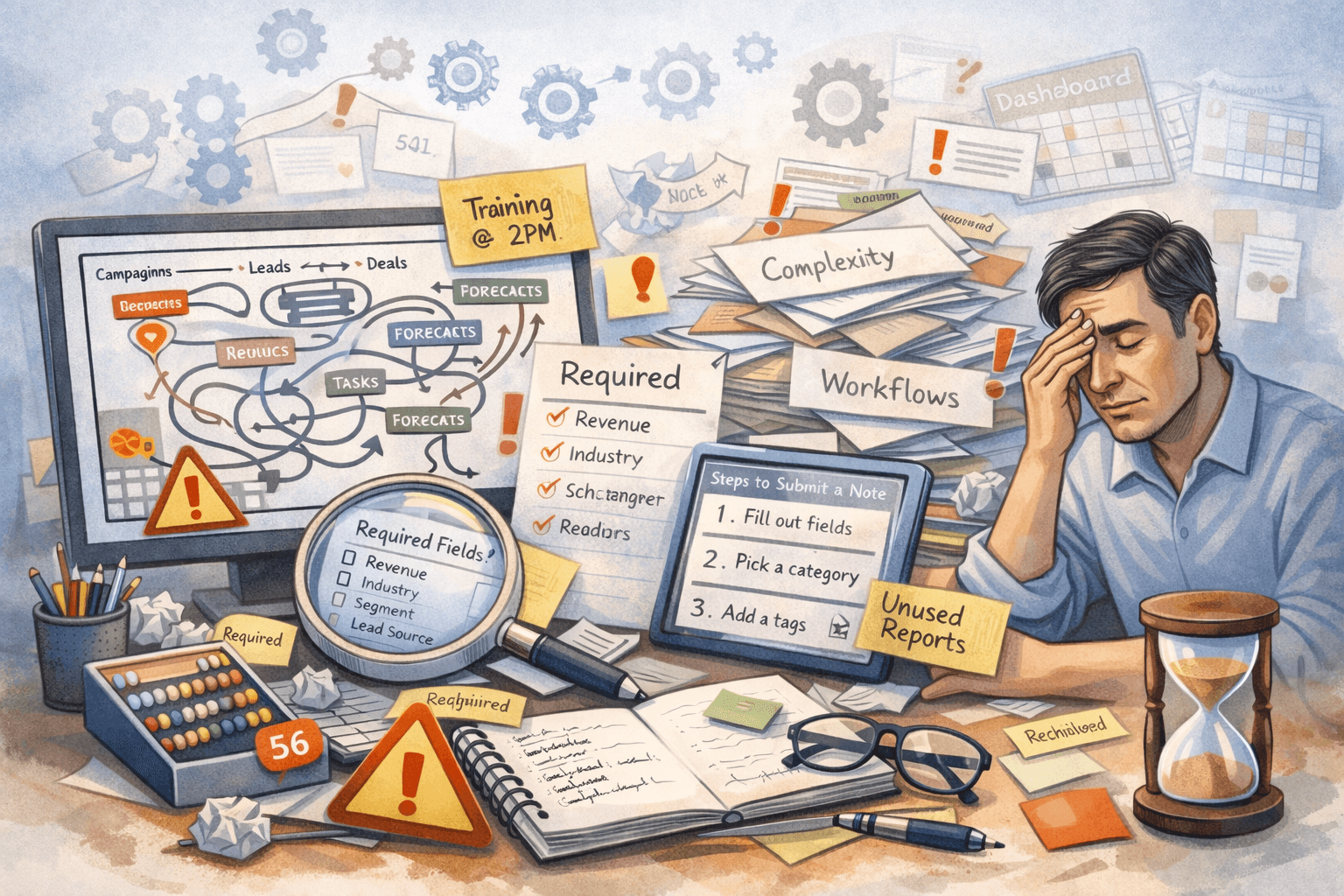
What starts as “let’s get organized” slowly turns into another system to babysit. More clicks. More fields. More rules. More time spent managing the tool instead of doing the work.
And it’s not because people are bad at using CRMs.
It’s because many CRMs are bloated with features.
How Complexity Sneaks In
Most CRMs are designed with this mindset: more features = more value.
Sounds reasonable. But in practice? That’s where things go sideways.
You end up with:
Required fields you don’t care about
Workflows that don’t match how you actually work
Sales features baked in even when you’re not selling
Dashboards no one checks
And training sessions just to do basic stuff
At some point, the CRM isn’t helping anymore. It’s just… there. Demanding attention.
That’s usually when teams start googling things like simple CRM or simplest CRM to use. Not because they want less capability, but because they want less friction.
When a CRM Becomes a Burden
You can feel it when it happens.
Only one person really knows how the CRM works. Notes get dumped in emails instead because it’s faster. Updates get skipped until “later.” New hires need walkthroughs just to get started.
And once people stop trusting what’s in the system, it’s game over. usability drops. The data gets messy. Everyone quietly works around it.
That’s why so many teams start looking for a lightweight CRM after trying a bigger platform.
Why This Keeps Happening
Here’s the honest answer: most CRMs are built for sales teams.
Pipelines. Deal stages. Forecasts. Automation rules. All useful if you’re closing deals every day. Not so useful if your goal is simply to manage client relationships and keep good documentation.
If you’re not living in a sales funnel, all that stuff just adds noise. What you really need are basic CRM tools that help you stay organized without forcing you into someone else’s process.
What a Good CRM Should Feel Like
A good CRM doesn’t wow you in a demo.
It just quietly does its job.
Here’s what that looks like.
It’s Easy to Use
You shouldn’t need training. Or a manual. Or a “CRM expert” on the team.
A no training CRM works the way you expect it to. You open it. You know where things go. That’s it. No learning curve. No overthinking.
It Focuses on Relationships
Not everything is a deal. Some clients are long-term. Some relationships evolve slowly. A good system supports that.
That’s where a CRM without complexity really shines. It keeps context. History. Notes that actually matter.
Documentation Is Simple
If writing things down feels like work, people won’t do it. Period.
Good systems make documentation quick and painless. A note here. An update there. No ceremony. That’s why simple CRM setups tend to win long-term.
It Stays Out of the Way
This part matters more than people realize.
A lightweight CRM doesn’t force fields you don’t need. It doesn’t lock you into rigid workflows. It adapts to you, not the other way around.
That’s also why tools with a no learning curve CRM approach get used more consistently. They don’t interrupt the flow of work.
Simpler Systems Actually Scale Better
There’s a belief that simple tools don’t scale.
But honestly? The opposite is usually true.
Simple systems scale because people use them. Data stays current. New team members don’t feel lost. Knowledge doesn’t live in one person’s head.
We’ve seen teams do this well by moving to tools built specifically for non-sales workflows, things like lightweight CRMs that focus on relationships and documentation instead of pipelines and forecasts.
That philosophy is what guided us when building Rel8hub: where usability and simplicity are everything.
In the End
If your CRM feels like another job, it’s not doing its job.
The best systems don’t demand attention. They give it back.
You don’t need more features.
You need less friction.